

For decades, social nudists and naturists have worked to explain a simple but often misunderstood truth: social nudity is not inherently sexual. Yet the language traditionally used to communicate this—phrases like “it’s not about sex” or “our relationships are non-sexual”—may unintentionally reinforce the very misconceptions naturists seek to dispel.
Words matter. They shape perception, frame understanding, and influence whether people approach an idea with curiosity or suspicion. When naturists define themselves by what they are not, they remain in a defensive posture, keeping sexuality at the center of the conversation even while denying it. This has limited the public’s ability to fully understand the true nature of naturist social interaction.
It is time to change how naturism is described—within the nudist community and to the broader public. Rather than relying on negative definitions, naturists need language that clearly and positively conveys the true nature of their relationships: platonic.
What is a platonic relationship?
A platonic relationship is a close, caring, emotionally meaningful bond between people that does not involve sexual or romantic intent. The term comes from the ancient Greek philosopher Plato, who described love as existing on many levels—intellectual, emotional, spiritual, and social—not solely physical.
Think of your closest friend, a trusted mentor, or a longtime companion. You may care deeply for them, enjoy their company, and feel affection for them, yet sexual attraction is not part of the relationship. That is platonic…and it is the lived reality of naturist communities.
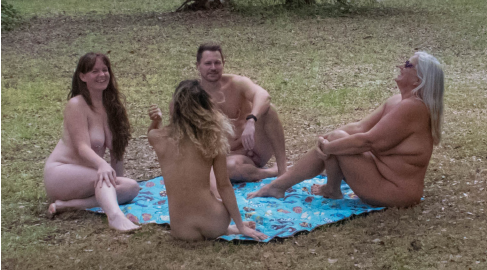
Whether sharing meals, swimming, playing volleyball, talking over coffee, or simply relaxing together, naturists engage in the same social experiences as clothed friends. The difference is the absence of clothing—but not the absence of boundaries. The relationships formed are built on friendship, trust, equality, mutual respect, and emotional safety.
Over time, in naturist settings, nudity becomes normalized. It fades into the background and loses its power as a sexual stimulus.
Instead, the focus shifts to the whole person—their character, humor, values, and presence. In this way, naturism creates an environment where authentic human connection is often stronger because superficial barriers are removed.
This is why the term platonic matters. Unlike the phrase “non-sexual,” which defines relationships by the absence of sex, platonic defines them by the presence of something meaningful: friendship and human connection. It is positive, relational, and immediately understandable. It shifts the focus away from what naturism denies and toward what it affirms.
A change in language can transform public understanding.
When people hear, “Naturists form platonic relationships,” they can connect that to a concept they already know: friendship without sexual expectation. It feels familiar, understandable, and less threatening. It helps dismantle the deeply ingrained cultural assumption that nudity and sexuality are inseparable.
To educate the public more effectively, naturists should move away from defensive explanations and adopt relational language.
Instead of saying: “We’re naked, but it’s not sexual,” say:
• “We relate to one another platonically.”
• “Naturism fosters platonic community.”
• “Social nudity normalizes the body and strengthens human connection.”
Education happens through stories, especially personal stories, not just definitions. Articles, interviews, podcasts, social media, and newcomer orientations all offer opportunities to explain naturism through the lens of friendship, trust, body acceptance, and healthy boundaries. These are experiences people can relate to, even if they have never been nude in a social setting.
The shift from “non-sexual” to “platonic” is more than semantics. It is a cultural reframing. It moves naturism away from defense and toward clarity, from misunderstanding toward understanding, and from stigma toward acceptance.
If naturism is to continue growing and gaining wider social acceptance, we must change the script. By consistently describing naturist relationships as platonic, naturists can define themselves on their own terms—and help the public see that meaningful human connection does not require clothing, nor does it imply sexual intent.
 About the author
Ronna E Krozy, EdD, RN
Former AANR Trustee and PR Chair
CHANGING THE SCRIPT: REFRAMING NATURIST RELATIONSHIPS AS PLATONIC